

Bajaj Chetak C25 vs TVS iQube vs Vida VX2: iQube excels as the all-rounder with proven comfort and service reach, Vida VX2 targets the longest range with removable batteries, and Chetak C25 focuses on robust build and urban efficiency at a sharp price. Choose by range needs, charging access, and budget.
In this Bajaj Chetak C25 Vs TVS iQube Vs Vida VX2 Comparison: Price, Specs, Range And More, we distill what buyers really ask on Google—price, range, charging time, features, and service. Drawing on official specs and top automotive reviews, here’s a clear, expert-backed guide to help you pick the right electric scooter for city rides and beyond.
- Quick Specs and Price (Snapshot)
- Who Is This For? (Search Intent Decoded)
- Design, Build, and Practicality
- Performance and Ride Quality
- Range: Lab (IDC) vs Real World
- Charging: Home, Office, and Public
- Features and Connectivity
- Warranty, Service Network, and Reliability
- Ownership Cost: What You’ll Actually Spend
- Which One Should You Buy?
- Expert Tips Before You Book
- Verdict
- FAQ
Quick Specs and Price (Snapshot)
Prices vary by state subsidies, dealer offers, and ongoing festive discounts. Treat IDC ranges as lab numbers; use real-world figures for daily planning.
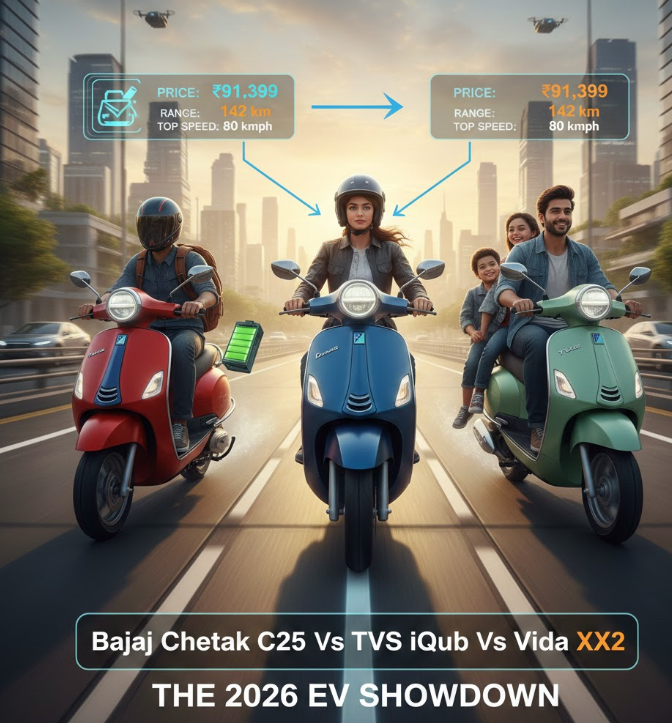
| Model | Ex-Showroom (Delhi) | Battery (kWh) | Peak Power | IDC Range | Real-World Range | Top Speed | 0–80% Charge |
| Bajaj Chetak C25 | ₹91,399 | 2.5 | 2.2 kW | 113 km | 80–90 km | 55 km/h | 2.4 hrs |
| TVS iQube (Base) | ₹94,434 | 2.2 | 4.4 kW | 94 km | 75 km | 75 km/h | 2.7 hrs |
| Vida VX2 Go | ₹99,490 | 2.2 | 6.0 kW | 92 km | 70–80 km | 80 km/h | 1.1 hrs* |
Who Is This For? (Search Intent Decoded)
- City commuters comparing electric scooters in India by price, specs, and range.
- Buyers choosing between Bajaj Chetak C25 vs TVS iQube vs Vida VX2 for comfort and reliability.
- First-time EV users seeking clarity on charging time, warranty, and service.
Design, Build, and Practicality
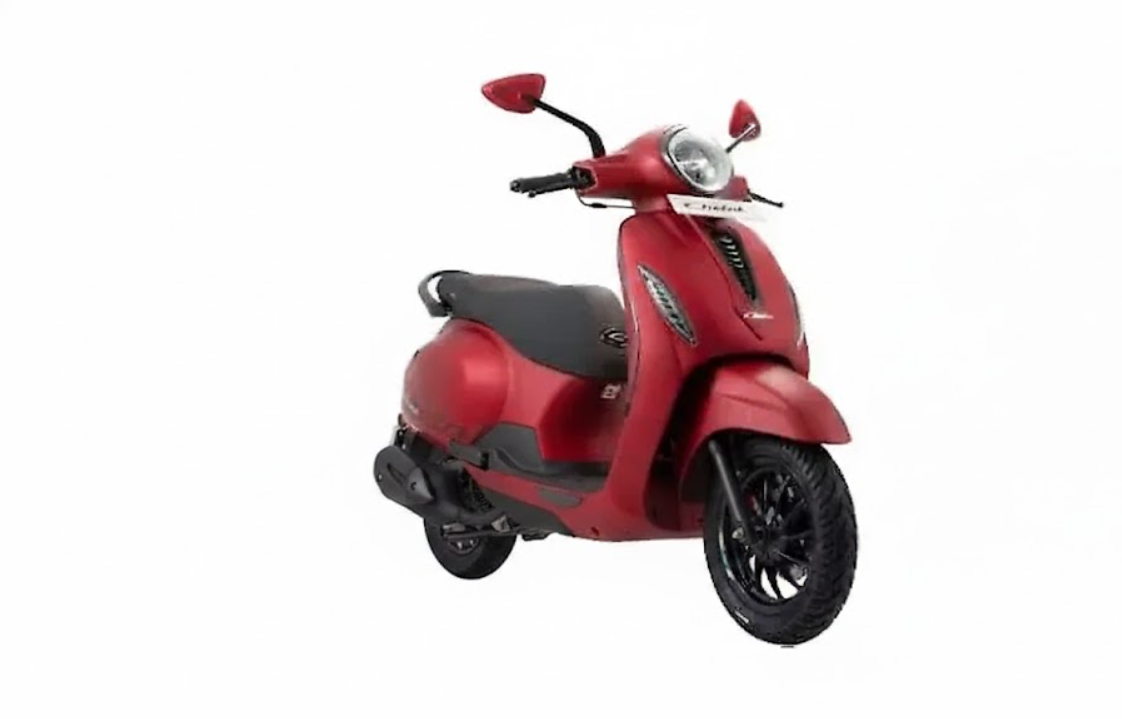
Bajaj Chetak C25 leans on a metal-heavy construction—solid panels, tight panel gaps, and a neo-retro silhouette. It feels robust in traffic and shrugs off small scrapes better than many plastic-bodied rivals, which city riders appreciate.
TVS iQube keeps the family-friendly formula: a comfortable, flat seat, neutral riding triangle, and a practical flat floorboard for carrying small bags. Its fit-finish and switchgear are consistently praised for quality and longevity.
Vida VX2 aims for modern, angular styling with an emphasis on under-seat practicality and removable battery access. Expect generous boot space, bright LED lighting, and robust grab rails for pillion confidence.
- Seat height: Typically 770–790 mm across all three, friendly for most riders.
- Tyres: 12-inch tubeless on mainstream variants, aiding stability and pothole absorption.
- IP rating: Expect IP67-grade battery enclosures; always confirm for the exact variant.
Performance and Ride Quality
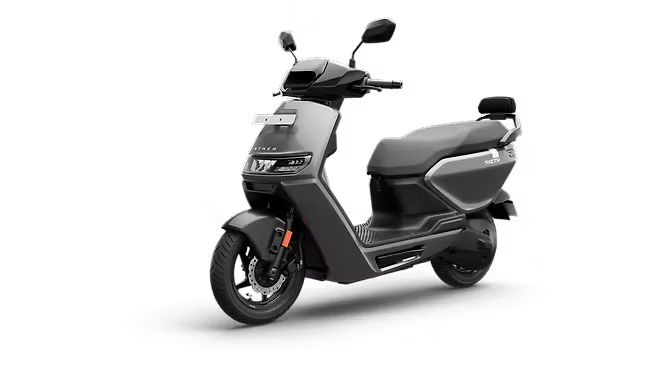
All three scooters deliver quiet, linear acceleration suited to dense traffic. The differences emerge in mid-range pull, throttle smoothness, and speed holding on flyovers.
Bajaj Chetak C25 focuses on smooth roll-on response and urban agility. The low-speed tractability is excellent, with predictable throttle mapping that makes U-turns and tight parking lots effortless.
TVS iQube is the most “ICE-like” in ride feel, confident initial shove, planted chassis, and calm manners over broken tarmac. It’s a commuter’s delight that doesn’t tire you out on longer city stretches.
Vida VX2, with a higher peak output, should feel zippier in overtakes and hold 60–70 km/h comfortably. If your commute includes fast arterial roads, the extra headroom helps.
- Brakes: Front disc + rear drum with CBS is common; lever feel and progression differ by brand.
- Suspension: Telescopic front + twin shocks rear; iQube skews to plusher tuning, Chetak to tighter control.
- NVH: EVs are quiet; tyre and wind noise become the main variables at 50+ km/h.
Range: Lab (IDC) vs Real World
IDC is a controlled-cycle figure. In Indian cities with stop-go traffic, riders typically see 70–85% of IDC, depending on weight, speed, tyre pressure, and ambient temperature. Cold mornings and constant 70+ km/h highway runs reduce range noticeably.
- Bajaj Chetak C25: Expect 90–105 km real-world with mixed riding in default mode.
- TVS iQube: 85–120 km real-world depending on variant (battery size) and riding mode.
- Vida VX2: 100–120 km real-world, aided by higher capacity and efficient regen.
Tip: Keep tyre pressure at recommended values, avoid full-throttle launches, and use coasting where safe. These small habits can unlock 8–12% more real-world range.
Charging: Home, Office, and Public
Most owners charge at home via a 5A/15A socket. Public networks help for top-ups and intercity hops, but routine overnight charging remains the most economical strategy.
Charging at a glance
– Home AC charger: 650–950 W typical (0–80% in ~3–5 hours depending on battery).
– Portable chargers: Standard with iQube and Vida; Bajaj supplies a wall unit; check variant.
– Removable batteries: Vida VX2 likely supports this; useful for apartment living.
– Public charging: CCS/GB/T support differs; use the OEM app to locate compatible stations.
Practical note: If your daily commute is under 40–50 km, any of the three will comfortably handle two days of use per charge, even with AC home charging only.
Features and Connectivity
- Displays: TFT or color LCD clusters with crisp readability; brightness auto-adjust is handy in noon sun.
- Smart app: Live tracking, ride logs, geofencing, and anti-theft alerts are now mainstream.
- Navigation: Turn-by-turn via Bluetooth tethering; verify map partner and data plan requirements.
- OTA updates: Rolling improvements to UI and energy management; keep scooters on the latest firmware.
- Ride modes and regen: Eco/City/Sport options with regenerative braking tuning; experiment to find your sweet spot.
Build extras matter too: Chetak’s metal bodywork ages gracefully; iQube’s consistent plastics and seat foam win commuters; Vida’s removable battery approach emphasizes flexibility for apartment dwellers.
Warranty, Service Network, and Reliability
Battery warranties commonly span 3 years/50,000 km to 5 years/60,000+ km. Motor and controller coverage varies by brand. Always read the warranty booklet for cycle count, SOH (state-of-health) thresholds, and exclusions.
- Bajaj Chetak C25: Strong dealer footprint in Tier-1/2 cities; metal panels simplify cosmetic repairs.
- TVS iQube: Among the widest service networks, fast turnaround times, good parts availability.
- Vida VX2: Growing footprint; check your city for authorized service and charging tie-ups before buying.
Ownership Cost: What You’ll Actually Spend
Electric scooters win on per-km cost and routine maintenance. Tyres, brake pads, and suspension consumables are your main recurring items; no oil changes or clutch issues.
Real-world cost example (illustrative)
- City electricity: ₹8/kWh
- Efficiency: ~35 Wh/km (0.035 kWh/km)
- Energy per km: 0.035 kWh × ₹8 = ₹0.28/km
A 1,000 km month costs ≈ ₹280 in “fuel.” Even at ₹10/kWh, it’s ≈ ₹350/month.
Insurance and on-road price swing with state EV incentives. Speak to dealers for the latest subsidy status before finalizing.
Pros and Cons
Bajaj Chetak C25
- Pros: Robust metal build, easy urban handling, efficient battery use, tasteful design.
- Cons: Smaller battery than range-focused rivals, fewer fast-charge options, limited under-seat space.
TVS iQube
- Pros: Balanced ride and comfort, wide service network, mature software and features.
- Cons: Mid-pack top speed, variant complexity (specs differ), charging times vary by battery size.
Vida VX2
- Pros: Strong real-world range, removable batteries, peppy mid-range acceleration.
- Cons: Service coverage still expanding, portability adds battery weight, pricing may vary city-wise.
Which One Should You Buy?
- Prioritize build and urban toughness: Pick Bajaj Chetak C25.
- Want a proven all-rounder with comfort and service reach: Choose TVS iQube.
- Need the longest range and removable batteries: Go for Vida VX2.
If your commute is under 35 km/day, any of the three will suffice. For 50–70 km/day, the iQube’s bigger-battery variants or Vida VX2 offer better buffer. For apartment charging constraints, Vida’s removable batteries add real convenience.
Expert Tips Before You Book
- Test ride all three back-to-back on the same route to feel throttle mapping and brake bite.
- Ask for battery replacement cost and prorated warranty terms in writing.
- Check tyre brand and size; swapping to a grippier compound can transform wet-road confidence.
- Confirm home charging cable length and approved socket rating with your electrician.
- Keep software updated; many range and UI refinements arrive via OTA.
Verdict
Bajaj Chetak C25 is the urban efficiency champ with a robust build, TVS iQube is the commuter’s all-rounder with class-leading service breadth, and Vida VX2 suits riders who want range headroom and removable batteries. Map your daily distance, charging access, and comfort preferences—your best choice will be obvious after a couple of test rides.
Running or reviewing an EV blog on WordPress? Host it on a fast, secure stack. At YouStable, we optimize WordPress performance with NVMe SSDs, server-level caching, and proactive security—so your comparison posts and schema-rich pages load instantly and rank better. Scale confidently as traffic grows.



Leave a comment