

Let’s be honest. Buying a new car in India is pure adrenaline. New paint smell, that first start, whole family waiting with sweets. I get it. I live for this moment too.
But here’s the kicker: skip the PDI (Pre-Delivery Inspection) or do it at the wrong time, and you can get stuck with a lemon. I’ve seen it happen. A friend took delivery of a shiny SUV, only to find a repainted fender, 180 km on the odo, and a year-old tyre week. Dealer said “normal”. Rubbish.
In my 15 years in the Indian auto space, I’ve learned one brutal truth—PDI is not just a checklist. It’s your shield. Done at the right time, it saves money, stress, and fights those sneaky dealership tricks.
So if you’re asking, “When to do PDI of car?”, this is the only guide you need. Super simple, Indian conditions, real-world hacks. No corporate bakwaas.
Read till the end. I’ll tell you exactly when to do PDI, where to do it, what to check, and how not to get scammed. Deal?
- PDI 101: What It Is And Why It’s Non-Negotiable
- The Perfect Timing: When To Do PDI Of Car (Exact Timeline)
- Where To Do PDI: Stockyard Vs Showroom
- The Ultimate India-Specific PDI Checklist (Simple & Brutal)
- FAQ
- Quick PDI Mini-Checklist You Can Screenshot
- Dealer Playbook vs Your Counter-Moves
- Who Should Do What (No Sugarcoating)
PDI 101: What It Is And Why It’s Non-Negotiable
PDI stands for Pre-Delivery Inspection. It’s a detailed check of your exact car before money, registration, and delivery. Not the demo. Not a random unit. Your car.
Why it matters? Cars travel by train and truck, wait in dusty stockyards, face monkeys, birds, rain, workers. Stuff happens. Scratches, shipping blocks left in suspension, dead batteries, even accidental repairs.
PDI is where you catch issues early. At this stage, you have power. Dealer hasn’t registered or invoiced it yet? You can reject and ask for a fresh unit. After registration? Tough game.
So timing is everything. Let me break it down step-by-step.
The Perfect Timing: When To Do PDI Of Car (Exact Timeline)
Short answer: Do PDI twice. First, before full payment and registration. Second, a quick re-check before delivery.
Step 1: After Allotment, Before Full Payment
Dealer calls you: “Sir, your car is allotted. VIN aa gaya.” This is your moment. Ask for the VIN and manufacturing month. Then demand PDI at the stockyard or dealership—wherever the car is parked.
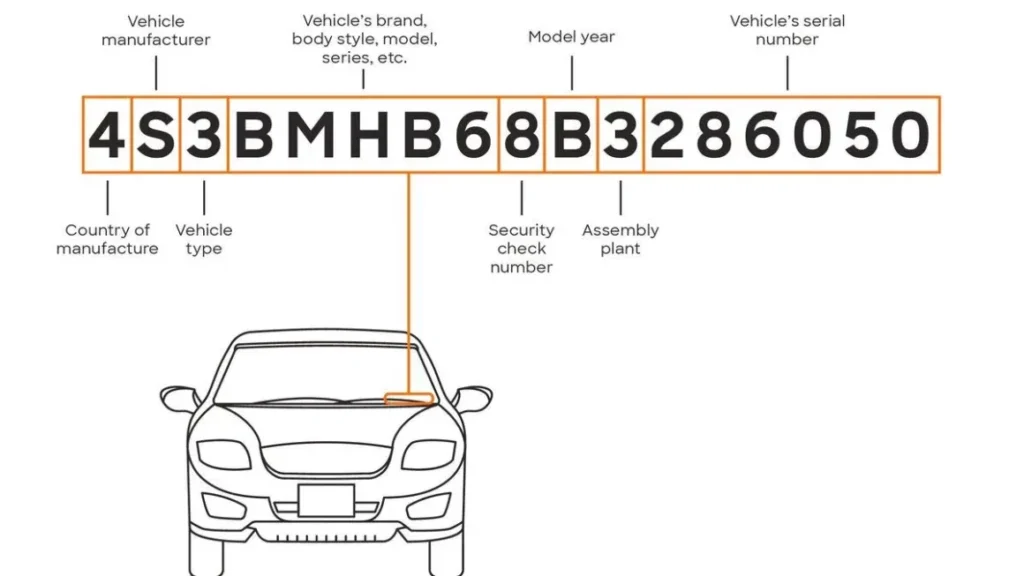
Pro tip: Pay only token/booking, not full amount. Keep your leverage. Your line: “I’ll do PDI first, then process the balance.” Simple.
Also check tyre week/year, battery brand, odo reading, paint, panel gaps, underbody. This is the heavy PDI.
Step 2: Before They Raise Invoice
Once you’re happy in Step 1, give a go-ahead for invoicing. Why care about invoice timing? Because after invoice, dealer becomes rigid. If you find a major fault post-invoice, refunds become slow.
So the rule is clear: PDI first. Then invoice. Not the other way around.
Step 3: Before RTO Registration
This is the last point of no return. Once your car is registered, it’s legally yours. If there’s a defect, you’re stuck with repairs, not replacement.
If anything feels off (repaint, dents, weird odo), pause registration immediately. Ask for a different VIN. It’s your right.
Step 4: On Delivery Day (Quick Re-Check)
Cars can get accessories, polish, and even scratches between PDI and delivery. So on delivery day, do a fast re-check. Lights, warning lights, infotainment, windows, spare wheel, tool kit, Fastag activation.
If something changed since PDI, note it on the job card before taking keys. Make them fix it first.
Where To Do PDI: Stockyard Vs Showroom
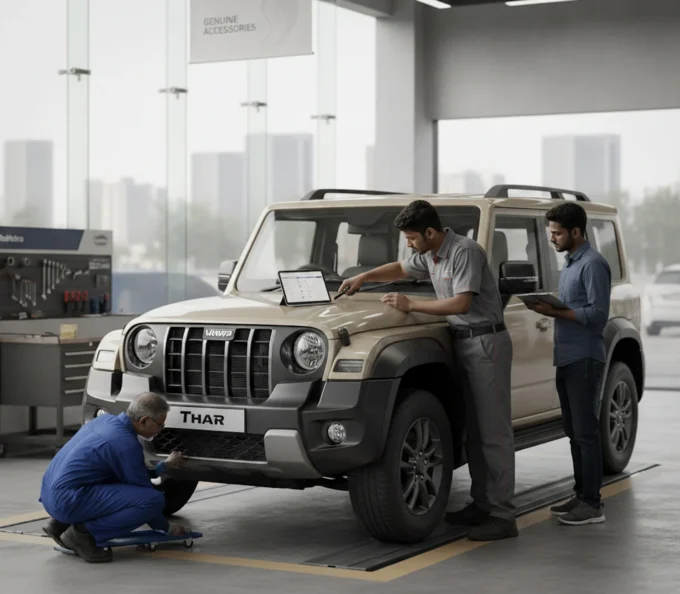
Stockyard PDI is best. That’s where the car sits in raw form—no polish, no cover-up, no spotlight hiding swirl marks. You see the real condition.
Dealers sometimes resist stockyard visits. Stand your ground. Be polite but firm. “I’ll only proceed after stockyard PDI.” Most agree.

Showroom PDI works too, just ensure it’s your VIN unit. Don’t accept a different car for inspection “because yours is in transit”. That’s a classic trick.
Daytime is ideal. Natural light shows paint flaws. Avoid rainy days—wet panels hide scratches and repaints.
The Ultimate India-Specific PDI Checklist (Simple & Brutal)
Carry: phone torch, microfiber cloth, tyre pressure gauge, OBD scanner if you have, and this checklist. Take your time. Don’t rush.
- VIN and Manufacturing Month: Match the VIN on the body, door jamb, windshield, and Form 22. Confirm manufacturing month/year. Avoid very old stock (generally >6 months unless rare model).
- Odometer: Ideal 10–50 km. Up to ~100 km can be normal for yard movement. Above that? Ask why. Note it in writing.
- Paint and Panels: Inspect in sunlight. Look for color shade mismatch, overspray on beading, uneven orange peel, masking lines—signs of repaint.
- Panel Gaps & Alignment: Open/close all doors, bonnet, boot. No creaks or rubbing. Check bonnet latch alignment.
- Tyres: Check brand, size, uniformity, and week-year code (e.g., 0925 = 9th week of 2025). Avoid very old tyres on a new car. Check spare tyre too.
- Wheels & Brakes: Look for rim scratches, shipping blocks removed, brake discs not heavily rusted. Spin each wheel slightly if possible.
- Lights & Electricals: Headlamps (low/high), DRLs, indicators, fogs, taillights, brake lights, reverse, cabin lights, all working with no moisture inside.
- Glass & Seals: No chips or cracks. Ensure window glass has same brand all around. Water test if possible for door beading.
- Interior Fit & Finish: Seat rails move smooth, seat covers clean, no stains, all switches tactile. No rattles on mild taps.
- Infotainment & Connectivity: Screen boots up quick, no dead pixels, Bluetooth/CarPlay/Android Auto works, speakers clear, reverse camera clean.
- AC & HVAC: Chills fast, blower quiet, all vents working, heater works too. Cabin air filter installed.
- Engine Bay: Fluids at correct levels (engine oil, coolant, brake fluid, washer). No leaks. Belt routing correct. Battery brand and health indicator green.
- Underbody: No major scrapes, loose panels, or fresh paint patches. Protective shipping plastics removed where required.
- Suspension & Steering: No clicks or clunks over small bumps in yard. Steering centered, no pull.
- Keys & Remote: Two keys present. Remote lock/unlock, boot release, request sensors working. Check emergency key blade.
- Safety: Airbag light turns on then off. ABS/ESC lights behave normal. If TPMS present, all pressures show right.
- Toolkit & Essentials: Jack, spanner, towing eye, triangle, owner’s manual, fastag fitted but not activated yet, HSRP plate status.
- Software & OBD (if you can): No stored DTCs. Pro-tip if allowed: a short 1–2 km loop in the yard to check straight-line tracking and brake bite. Only if dealer permits.
If you find a deal-breaker (repaint, accident repair, odo too high), reject politely and ask for a fresh unit in writing. Don’t compromise.
Documents To Check During PDI
Paperwork is half the battle. In India, this is where many get fooled. Don’t be that guy.
- Form 22 (Roadworthiness Certificate) with VIN, engine number, manufacturing date.
- Insurance draft (OD + TP). Verify name, IDV, add-ons like Zero Dep, RTI, Engine Protect if you opted.
- Proforma Invoice with exact variant, color, VIN, and breakup (ex-showroom, RTO, insurance, handling charges).
- No “handling/logistics/parking” charges—illegal in many states. Push back.
- Extended warranty and RSA terms if purchased.
- Accessory list with itemized prices. MGA/MGP for Maruti, OEM vs dealer add-ons for others.
- Temporary registration plan (if applicable) and RTO documentation. Check hypothecation details if loan.
Cross-check the VIN and engine number on the car with the documents yourself. Don’t just trust the sales guy.
Money Moves: Payment Sequence That Protects You
I’ve tested this with multiple dealers across brands. Works like a charm.
- Pay small booking amount first. Get allotment + VIN.
- Do full PDI at stockyard. Approve the unit in writing.
- Then release the balance payment and ask them to raise the invoice.
- Only after invoice, allow RTO registration.
- Delivery day: pay for accessories (if any balance) after verifying fitment and functionality.
If they pressure you for full payment “company policy”, politely say: “I’m happy to pay right after PDI. If not possible, I’ll consider another dealer.” Works 9/10 times.
Timing Hacks: Best Day, Season, And Situations For PDI
Time of day: Late morning to early afternoon. Natural light is your friend. Avoid twilight and night—showroom lights hide swirl marks.
Season: Avoid heavy rain days. Water hides flaws. Post-monsoon? Check under carpets for moisture—flood damage is real.
Festive rush (Navratri/Diwali): Dealers are swamped. Book your PDI slot early and take a friend. More eyes, fewer misses.
Month/Quarter-end: Negotiation power is high, but so are shortcuts. Double-check everything. Ensure your VIN is fresh and not leftover stock.
Accessories & Software: Fitment Timing That Saves Headaches
Never let them do heavy accessories (seat covers, alloy swaps, sunfilm where illegal, audio rewiring) before your first PDI. If you reject the car, they’ll make you wait for refunds or transfer.
Ask for OEM-approved wiring harnesses for stuff like dash cams, ambient lights. No juggad into fuse box. Your warranty matters.
Infotainment updates? Get them to install the latest firmware at delivery. CarPlay/Android Auto should be smooth from day one.
Pro-tip: Keep Fastag unactivated till delivery. Else it gets complicated if the unit changes.
Red Flags: When To Walk Away (And What To Do)
If you see mismatched paint, overspray, odo beyond reason, damaged tyres, airbag light errors, or major rattles—pause immediately.
Tell the CRM in writing: “I’m not satisfied with this VIN. Please allot a fresh unit.” Attach photos. Keep everything on email/WhatsApp for record.
If they refuse PDI or push back hard, escalate to brand customer care. Tag them on social media. Ask for refund of booking if they won’t cooperate.
Remember: once registered, the battle becomes repair vs replace. Your best chance is before RTO.
FAQ
Quick PDI Mini-Checklist You Can Screenshot
- VIN/manufacturing month matches docs
- Odo within 10–100 km, ideally under 50
- Paint uniform, no overspray/mismatch
- Tyre week-year recent; spare present
- All lights, horn, wipers, windows working
- Infotainment, Bluetooth, CarPlay/AA smooth
- AC chills fast; heater works
- Fluid levels okay; no leaks
- Toolkit, spare key, owner’s manual present
- No warning lights after engine start
- No illegal “handling” charges on invoice
You can try our online free cars pdi checker tool for the best & accurate report.
Dealer Playbook vs Your Counter-Moves
“Sir, PDI not allowed before payment.”
Reply: “I’ll pay right after PDI. If not possible, I’ll book with another dealer.”
“This is normal, happens to all cars.”
Reply: “Great, then allot me another unit. I’ll wait.”
“Handling charges mandatory.”
Reply: “Please remove. Not permissible in many states. Else I’ll escalate.”
Stay calm, be firm, and always keep proof in writing. Works every single time.
Who Should Do What (No Sugarcoating)
If you’re buying any new car in India—hatchback to luxury—do PDI before full payment and before RTO registration. Non-negotiable. Doesn’t matter if it’s a hot-seller with waiting period or a discount queen.
Who benefits the most? First-time buyers, those picking from yard stock, year-end deals, demo-clearance units, and anyone buying during/after monsoons. Risk is higher, so PDI is your helmet.
Who should avoid skipping PDI? Everyone. Even if you trust your SA like family, humans make mistakes. A 45-minute PDI saves you months of post-delivery drama.
My bottom line as a guy who’s lived cars for 15 years: Don’t let the excitement hijack your brain. Nail the timing, follow the checklist, and walk out with a beast you’ll love for years—with zero regrets.
If you want, reply with your car model and city. I’ll share a brand-specific PDI tip-sheet from my notes—free, no nonsense.






Leave a comment